David Sims photographed Natasha Poly & Isabeli Fontana for American Vogue on November 23 & 24 at Pier 59 Studios, Studio #4, with stylist Grace Coddington.
American Vogue March 2009 Models: Isabeli Fontana & Natasha Poly Photographer: David Sims Stylist: Grace Coddington Makeup: Diane Kendal Hair: Guido Palau
Tommy Hilfiger Fall 2009 Show Time: February 19, at 10:00 am Location: Bryant Park, The Tent, West 40th Street Stylist: George Cortina Casting Director: Jessica Weinstein Makeup: Lisa Butler Hair: Luigi Murenu
Frank Tell Fall 2009 Show Time: February 14, at 6:00pm Location: The Tribeca Grand Hotel, 2 6th Avenue Stylist: Tom Van Dorpe Casting Director: Tom Van Dorpe
Karen Walker Fall 2009 Show Time: February 14, at 12:00pm Location: The Altman Building, 135 West 18th Street Stylist: Heathermary Jackson Casting Director: Barbara Pfister
Solve Sundsbo photographed Vlada for the Christian Lacroix Absynthe perfume campaign on May 21 & 22, 2008.
Christian Lacroix Absynthe perfume campaign Model: Vlada Roslyakova Photographer: Solve Sundsbo Stylist: Melissa Klitzke Makeup: Diane Kendal Hair: Jimmy Paul Location: Milk Studios, 450 West 15th Street, Studio #3
“IT’S survival of the fittest at this point,” the designer Anna Sui said cheerily last week, as she glided around her Garment Center workroom, a space crammed with vintage mannequin heads, clothes racks, books and trimmings. She was referring, of course, to the nine days of fall collections that begin on Friday in lofts around the city and at the Bryant Park tents.
It has been many seasons since Ms. Sui first showed clothes on a runway, starting in 1991 when she unveiled a feminine style that evokes an addled ingénue unafraid of a drink or of letting her knickers show: Lily Allen almost before the British singer and It Girl was born.
The clothes in Ms. Sui’s first show were modeled by pals, among them Linda Evangelista and Naomi Campbell. That those professional beauties were then at the height of their fame helped stoke the reception the designer got from buyers and the news media, and it also insured industry embrace of a talented designer who had, until then, been working quietly and anonymously on other people’s lines.
Encouraged by other friends who included the makeup artist Pat McGrath and the photographer Steven Meisel, Ms. Sui hacked out a niche, to which two decades later, she is holding tight.
Unlike Marc Jacobs, Ms. Sui is not the designer the press looks to for cues to the immediate future of style. Compared to the $13 billion juggernaut Ralph Lauren forged, her business is relatively mom-and-pop. Critics have carped about the sameness of Ms. Sui’s designs, calling them overly thematic, too whimsical and — design death — cute. Yet her fan base remains loyal, and that is partly why Sui’s career seems to represent the kind ardently sought by design school students and “Project Runway” aspirants.
It is a career that, it almost goes without saying, is now buffeted by the deepest consumer retrenchment in a generation, the kind of economic wind shear that has already driven some designers into involuntary retirement and caused others to abandon the idea of earning any profits at all this year. Ms. Sui — neither household name nor dewy upstart — is part of the broad middle of the 200-designer Fashion Week spectrum, an emblem of the many creative talents facing a new runway season with a mixture of cautious optimism and outright dread.
Born in Detroit and educated at Parsons School of Design, Ms. Sui made all the journeyman stations of the cross before achieving overnight success when she was close to 40. Her company is privately held and remains profitable, she says. (Dun & Bradstreet estimates annual sales of $20 million.) Her clothing label is substantially underwritten by earnings from the 14 global fragrance and cosmetics licenses she operates in partnership with Procter & Gamble and her 42 store franchises in China, Japan, Taiwan and Kuwait.
Unlike many designers faced with imminent catastrophe, Ms. Sui is able to ride out a bad season and perhaps a bad year. Yet, like everyone in the trade, she feels the Darwinian chill that recession has cast on businesses of all kinds. “It’s never a sure thing,” she said. “I have a big responsibility to my licenses. All my licenses draw from and take ideas from the runway.” Thus, a show that will spotlight cardigans and dresses will also provide the pattern for a handkerchief sold in Tokyo.
“It’s not just designers who are affected,” by the impact of the economy on fashion, she said. As a longtime advocate for preserving the Garment Center, Ms. Sui is attuned to the perils to the industry over all when any designer or collection fails. Long before the recession hit, high rents had driven businesses out of the area. Employment in the apparel trade has shrunk drastically from its 1950s peak of 250,000 jobs to fewer than 20,000 today.
Without a production core, it becomes increasingly difficult for young designers to set up shop in the city, Ms. Sui said. “When I was starting, there were wool mills in the U.S. that could make you anything,” Ms. Sui said. “The U.S. used to produce the most beautiful cotton denim in the world. Now all that is gone.”
A person walking down Seventh Avenue runs little risk anymore of being mowed down by a pushcart. Just a handful of workrooms remain that can whip up custom trimmings, and there are few skilled workers capable of operating the bulky machinery required to make gossamer fripperies like Schiffli lace. Come 2010, when the runway shows move from Bryant Park to Lincoln Center, the last symbolic link between Seventh Avenue and Fashion Week will also be lost.
Fashion was a radically different business when she was starting out in the 1980s, Ms. Sui said — less corporate, more subject to the whims and intuitions of gifted merchants and also influenced by the fact that department stores could still afford to showcase unknowns thanks to open-to-buy budgets.
“Every decision is harder for everyone to make now because things are so expensive,” Ms. Sui said, referring both to the steep cost of retail goods and the expenses designers incur to produce and mount collections two times a year.
“You have to ask yourself, ‘Is it worth the investment’ ” of paying $50,000 to rent space in the tents at Bryant Park, an additional $100,000 on production elements that include hair and makeup and dressers and sets and lighting and music, and even the food backstage.
A budget for models can run to hundreds of thousands of dollars per show, although it is an open secret in the business that there is no such thing as a fixed rate for a model’s services. These line items are all separate, of course, from the outlay required to create and produce the elements of a collection — the trims, shoes, boots, bags, accessories and hosiery.
“It’s all scary when all you hear is that nothing is selling,” Ms. Sui said. Yet, “no on has ever found a solution for not doing a fashion show,” she added.
And so late in 2008, she began building up mood boards, the inspiration flashcards created from tear sheets, postcards and scraps of cloth, and abstracting from a visit to the Fortuny Museum in Venice the germ of a collection based on beauties of the Belle Epoque.
She devised a striped floral jacquard print reminiscent of a Vuillard interior. She began conjuring “a Proustian feeling, although I knew nothing about Proust,” she said, by reading “Swann’s Way” and scouring Netflix for Max Ophüls films.
At the Linea Pelle leather fair in Bologna last October, Ms. Sui began making the first of countless small decisions that go into each designer collection, shoes always preceding clothes because they require a long lead time to produce.
“You have to try to predict where things might go,” Ms. Sui said. Because designers have to calculate for shifts of taste within a season, she has also staggered the colors of her new collection to jibe with a shipping cycle that alters every six weeks, the hues becoming brighter as winter turns into spring. “I don’t have the luxury of making clothes just to make an effect,” Ms. Sui said. “It can’t be something totally frivolous, because my distributors have to have a successful season, too.”
THE task facing Ms. Sui, and all designers, in the current climate is “how to shake it up and make it different” without going too far, she said. “More than ever, you’re mindful of things that didn’t work in the past. You’re mindful of fabrics costing $5 more a yard. Once you start putting in markups on things like that, it turns into two or three times that at retail. And you are not going to sell something that is out of a reachable range.”
It is safe to say that what captures the attention of the 1,200 or so people who will pack the space known as the Tent — one of two runway spaces under the big top in Bryant Park — for Ms. Sui’s show next Wednesday, will be the lace-trimmed frocks, the piled on leggings, the sexy girls loping down the runway to the quirky rock soundtrack that is a Sui signature.
Backstage, waiting to take her usual modest bow, the designer will be focused on the question of whether this show will find a sweet spot and if it can stimulate enough interest to generate the $6 million in wholesale orders called for in her business plan.
“All you can really do at this point,” she said, “is hope for a collection that will send you to the moon.”
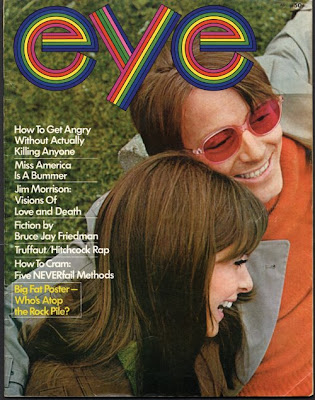
Eye Magazine was published by the Hearst Corporation (Harper's Bazaar, Cosmopolitan, Good Housekeeping) to cover the emerging youth explosion of the 1960's. It was marketed to college students (male & female) covering fashion, music, and politics.
Most issues came with a bonus item inserted for the reader (Posters, record, comic book). The last three issues had no insert. There were only 15 issues published between March 1968 and May 1969.
1968 & 1969 were wild times of women's liberation, gay liberation and civil rights. Those years also coincided with the Vietnam War.
Why Cops Hate Students
Meet Julie Driscoll: Britain's Trendiest Rock Star
Sexy nice girls in their summer underwear
Laura Nyro - New Rock Princess
The Rolling Stones: "drugs and young girls...absolute dirt." Or not?
Mother jealous of your freer sex life?
Sorcerer of Rock: Jim Morrison Raps
Witch or Warlock? Test your Potential.
Live Your Wildest Fantasies...& Get Paid For It?
The Dylan Gang
How to Get Angry Without Actually Killing Anyone
Miss America Is A Bummer
How 18-Year-Olds Can Win The Right To Vote
What A Young Man Can Learn From An Older Woman
Grace Slick, Peter Fonda, Julie Nixon and Frank Zappa Tell What Turns Them On
The Martyrs Who Live On - JFK, RFK, Che, Malcolm X and Martin Luther King
Payola 1968 - Does Money Decide Which Songs You Hear?
On Saturday morning, I was reading the Sunday New York Times (no, I don't live in the future, I subscribe, and receive the NY Times Magazine, T Magazine and the Arts sections of the New York Times on Saturday) and saw an amazing article about Ryan Trecartin.
I was excited to see a young American artist celebrated and encouraged by The Grey Lady.
THE shoot the night before had lasted into the next day, ending around 9 a.m. after a scene in which the perimeter of the kidney-shaped swimming pool had been set ablaze with rubbing alcohol. So when the artist Ryan Trecartin greeted a visitor that afternoon, sleepless for more than 24 hours, he ran his hands through his hair and said, “This really isn’t me.”
He meant that he wouldn’t be much good for an interview. But he could just as well have been speaking in the voice of one of the maniacally mutable characters he plays in the videos he has been writing and directing for the last several years, characters whose hold on identity and existence itself seems so tenuous that they must keep talking to keep from disappearing. (“If I didn’t take the liberties to glue these prop knobs onto my safe space, who would you think that I’d be?” demands one, in what has become Mr. Trecartin’s signature unhinged vernacular: phrases that sound like something you might have heard before, on television or the Web, but haven’t.)
Mr. Trecartin (pronounced tra-KAR-tun) was creating these characters more or less for himself and a band of friends and collaborators from the Rhode Island School of Design when one of his works, posted on his Friendster page, was seen in 2005 by the artist Sue de Beer, who brought it to the attention of a curator at the New Museum in Manhattan. In stunningly short order, even for an art world then still moving at breakneck speed, his work was everywhere: the 2006 Whitney Biennial, the J. Paul Getty Museum in Los Angeles, the Saatchi Gallery in London, the collection of the Guggenheim Museum. And his most ambitious work to date, the movie-length “I-Be Area,” which made its debut in 2007 at the Elizabeth Dee Gallery in Chelsea, was greeted with a kind of joyous critical consensus rarely seen in the art world.
Mr. Trecartin, a friendly, loquacious, boyish-looking man who grew up in a steel-mill family in rural Ohio and who counts the Disney Channel and “Dirty Dancing” among his important artistic inspirations, was only 26 years old.
So there has been a lot of anticipation about what he will come up with next. And for the last five months Mr. Trecartin, now 28, has been working long hours to meet it in a slightly ramshackle Spanish-mission-style house on the edge of the Little Haiti neighborhood here that he has rented for $2,000 a month and that serves as set, dormitory, editing suite, sculpture studio and site of a kind of continuous happening. The work that emerges — conceived now as a trilogy, two parts video and the third a performance — will take him back to the institution that helped discover him, the New Museum, where the video portions will be a key part of “Younger Than Jesus,” the museum’s first installment of a new triennial that will focus on the work of artists under 33, opening on April 8.
The raw material for Mr. Trecartin’s new work is what is happening to the world economy as financial institutions implode and the mechanisms of capitalism and credit falter. So the house he has adopted as his temporary home is fitting: it is near the city’s Design District, which has become an art-world hot spot in recent years, but in a rapidly changing middle-class neighborhood now dotted with foreclosure signs amid the crabgrass.
Even the reason he came to Miami plays well into his story line about transition. He originally arrived to make a smaller project at the request of the nonprofit Moore Space here, founded by the prominent collectors Rosa de la Cruz and Craig Robins, but they closed the space unexpectedly in October, in an example of the reordering that is beginning to unfold in the art world.
So with help from his gallery, collectors, the New Museum and several of his own beleaguered credit cards, he rented the house and began making sets and costumes with his friend and closest collaborator, Lizzie Fitch, and others. As filming began, he welcomed a steady stream of friends and regulars, along with professional actors — considerably more than he has used before, drawn partly from the child and teenage performers in Orlando, home of Walt Disney World and Universal Studios.
When a reporter arrived at the house the day after the all-night shoot, Ms. Fitch was still asleep in the pool house, and the sun-splashed backyard was strewn with what looked like the aftermath of a small riot or a ritual for a new Day-Glo religion. Bricks lay everywhere around a brightly colored prop wall. Lifelike models of tiny purse dogs were scattered in the weeds. A white metal bed frame from Ikea was submerged in the pool. (Ikea and Target are the main sources of furniture and props for the project because of their ubiquity and faux-designery corporate blandness, Mr. Trecartin said.) Above the pool was a wooden armature rigged with a pulley that had been used to lower the artist into the water the night before, a deus ex machina in canary yellow shorts.
Asked how the neighbors reacted to such doings, he said that the house on one side was boarded up and occupied by squatters whom few people had seen. The eaves and roof of the large house on the other side are covered with security cameras, like vultures. No one is quite sure what its residents do.
“There’s a lot of really weird things going on at our house,” Mr. Trecartin said. “But those guys have these huge parties and actually make more noise, so they don’t complain.”
The shoots and plots have grown substantially more complex since his days in Rhode Island and later, with many members of his group, in New Orleans, where they lived until Hurricane Katrina destroyed their house and much of Mr. Trecartin’s work.
In “A Family Finds Entertainment,” the video that brought him to public view, the fairly followable story involves a disturbed and disturbing black-toothed kid named Skippy (played by Mr. Trecartin) who borrows money from his parents, is filmed by a documentary maker, is hit by a car, is filmed by the documentary maker some more as he lies in the road, and whose soul seems to rise from his body when it hears the sounds of a rocking house party.
By “I-Be Area” Mr. Trecartin’s characters had started to serve more as vehicles for his hyperactively interconnected ideas about family, belonging, identity, gender, the Internet and the entertainment industry. But they are much more fascinating than allegorical characters generally have a right to be, with names like Pasta and Jammie, yakking endlessly, arrogantly, pleadingly, in phantasmagoric makeup and crazy clothes. The title character, I-Be, is less a person than an idea of a person waiting to hijack or be hijacked by a personality. (To make things more interesting, I-Be has a clone, and the clone has an online avatar who seems to be mounting a rebellion; the clone and the avatar are both played by Mr. Trecartin in a Southern accent that sounds something like Carroll Baker’s in “Baby Doll,” except on acid.)
In one Web interview Mr. Trecartin helpfully described a chaotic scene in a macabre wood shop near the end of the video as “a conceptual part-cyber-hybrid platform that obeys and functions within both laws of physics and virtual-nonlinear reality and potential in Web 2.0/ultra-wiki communication malfunction liberation flow, add-on and debate presentation.”
In an interview two days after the all-nighter, Mr. Trecartin, with a full night’s sleep, said the new work, as yet unfinished and untitled, was using the dire state of the economy to describe a world in a state of epic, maybe never-ending transition. It is a place where the idea of credit becomes so abstract that “credit cards start to have conceptual agendas” and where people create and use their own currencies. The Web becomes a catalyst for a “postgender world,” said Mr. Trecartin, who is gay. Transvestites would not be the usual kind but instead “astrological trannies” or “personality trannies,” choosing to exist in a state of not quite being one person.
Sitting in his office with Ms. Fitch, the walls behind him covered with circular diagrams that he said helped him keep track of characters, ideas and situations, he tried to describe parts of the numerous plots, which seem to collapse into one another like the perspectives in an Escher drawing.
“This is really hard to describe linearly,” he said at one point. At another, trying to sum up after a long, rambling disquisition, he said, “It’s all just driven by situations in a personality-based system,” causing Ms. Fitch to laugh and double over in her chair, because she has watched him go through these kinds of patient — and quite sincere — gyrations before.
Massimiliano Gioni, the director of special exhibitions for the New Museum, said he often used the term “hysterical realism” — a phrase invented by the critic James Wood to characterize the overly manic language and story lines of fiction by writers like David Foster Wallace and Don DeLillo — to describe Mr. Trecartin’s work and that of several other younger artists. But in their art, he said, the hysteria is raised to even more absurd heights, a reflection of the world they have inherited, drowning in information and images.
“It’s as if information is speaking the characters rather than the other way around,” Mr. Gioni said.
Lauren Cornell, the executive director of Rhizome (rhizome.org), the online art organization affiliated with the New Museum, said that though it was too limiting to describe Mr. Trecartin’s work as being about life lived largely on and through the Web, “he really captures how the logic of it is becoming embedded in our lives.”
The garish low-budget look and feel of his work, and its near-anarchy, are often compared to early John Waters, to Paul McCarthy, to Mike Kelley and to drag auteurs like Jack Smith and Tom Rubnitz. But when asked, Mr. Trecartin said that he could not think of a work of art, video or otherwise, that had inspired him to want to become an artist. Ms. Cornell said that in long conversations with her in 2007 he told her that when he was first compared to Mr. Waters or to Mr. Smith, he had never heard of them.
“When I was young and my baby sitters came over and turned on music videos, I was inspired by that,” Mr. Trecartin said in his office, where a desk with a large Mac monitor and 10 hard drives shares space with the rumpled mattress he often sleeps on. He said he also reads obsessively, almost completely online, and is feverishly devoted to conspiracy-theory sites and TED Talks, the brainy Web lecture series.
Ms. Fitch interrupted him disapprovingly: “Ryan, I’ve seen you look at a piece of art and be inspired by it.”
Mr. Trecartin responded: “Yeah, but what? I really want to be reminded.”
He said his goal when he begins to write — the dialogue in his works, despite seeming ad-libbed, is highly scripted — is for viewers to leave his work with a deep emotional response to a reflection of their culture, “but in a way that they really can’t put their finger on why they felt like that.”
While he is ecstatic about his success among curators and collectors, he has an online audience that is just as important to him, one that doesn’t approach his work as art per se. Speaking of an earlier work in an online interview, he once said that if it fared well only among art-world people, “then I’ll feel like a loser.”
But judging from some of the comments on his YouTube channel, he is doing well by his other audience too. “That one hour, 48 minutes was the closest I’d come to someone who could understand me,” wrote a viewer with the screen name Scandibilly after watching “I-Be Area.” “Thank you! Thank you! I understand!”
Although he was born in 1981 into the first home-computer generation, Mr. Trecartin said he thinks that people even younger, who have never known a world without the Web, are the ones who understand his work most intuitively. He told of hiring several teenage actresses for his new video. He tried to explain the ideas for their surreal characters by simplifying them, but it wasn’t working, so he just explained it the way he would have to himself. “And they were like, ‘Oh, yeah, O.K.’ ”
“People born in the ’90s are amazing,” he said excitedly. “I can’t wait until they all start to make art.”
Tom Munro photographed Rianne Ten Haken for the spring 2009 A/X Armani Exchange campaign on October 21, 22 & 23 in Miami, Florida.
A/X Armani Exchange spring 2009 campaign Model: Rianne Ten Haken Photographer: Tom Munro Stylist: Victoria Bartlett Makeup: Mark Carrasquillo Hair: Neil Moodie
WOMEN Management was founded in New York in 1988 with an inspiration to expand the definition of beauty. Over the past two decades, WOMEN has launched the careers of models such as Carmen Kass, Isabeli Fontana, Iselin Steiro, Natasha Poly, Fei Fei Sun, Anna Ewers, Kasia Struss, Valentina Zelyaeva, Julia Stegner, Kate Moss and Shana Zadrick.
In 2003 offices in Milan and Paris were opened to further the management vision of WOMEN worldwide.